Beyond the Hype: 5 Strategic Takeaways from CES 2026
Quick Summary for Busy Leaders:
- The Big Theme: CES 2026 marked the shift from Generative AI (creating text) to Agentic AI (taking action in the real world).
- Key Innovation: “Physical AI” and Digital Twins are now mature enough to simulate business supply chains before money is spent.
- The Risk: Companies without clean data infrastructure will be unable to use these new tools.
- Our Verdict: Don’t buy the robot yet; build the API infrastructure the robot needs to talk to.
The Power of Two Perspectives (featuring Steven Burkett)
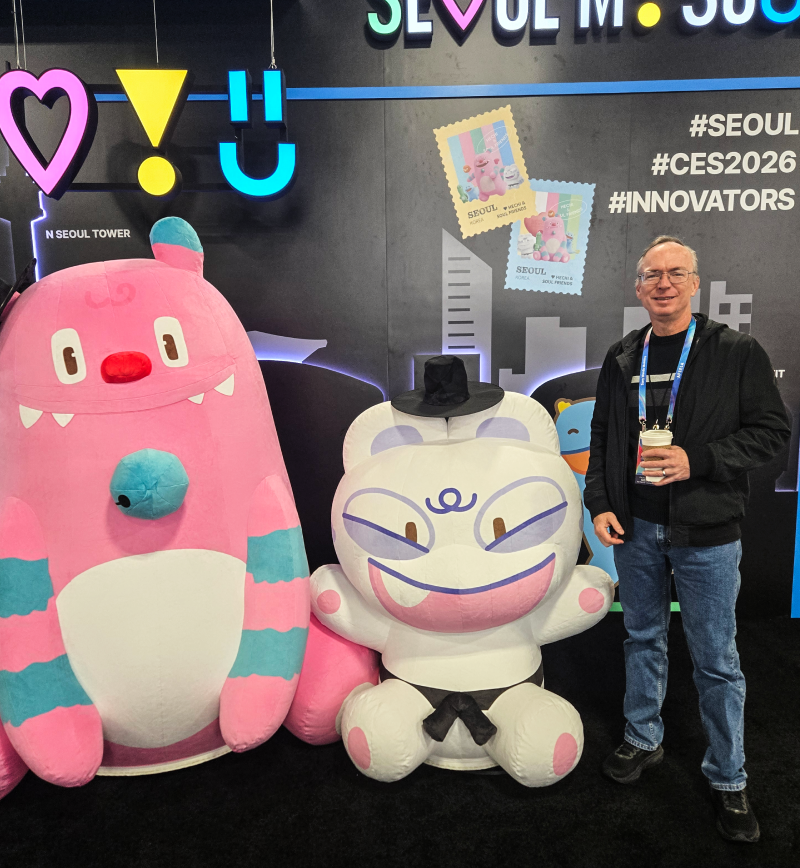
Walking the floor of the Las Vegas Convention Center for our first trip to CES was an assault on the senses. The noise, the lights, and the sheer volume of “next big things” can be overwhelming. However, walking the floor with a deep technical expert like Steven made the experience unique. With my husband and Precipex founder by my side, the signal quickly separated from the noise.
The strategic highlight of the trip was securing VIP passes to the Siemens keynote. Sitting front and center to watch Siemens CEO Roland Busch invite NVIDIA’s Jensen Huang on stage was a masterclass in the future of industry. Seeing these two giants discuss the “Industrial Metaverse” made it clear that digital transformation is no longer just about software. It is about fully simulating the physical world.
While I was absorbed in the strategy of that keynote, Steven was having a field day with the hardware on the floor. He was genuinely captivated by the new wave of robotics, analyzing their motion and autonomy with pure excitement. But the real showstopper for him wasn’t a robot; it was the Caterham Project V. In fact, he left the show ready to put a deposit down on the electric sports coupe, proving that even a pragmatic technologist can fall for a beautiful piece of engineering.
Together, we realized that CES 2026 wasn’t about gadgets. It was about a fundamental shift in how AI operates. The conversation has moved beyond generating text to integrating intelligence into physical workflows. Here is what that shift means for your business.
What was the biggest AI trend at CES 2026?
The Direct Answer: The biggest trend was the move toward Agentic AI. Unlike the chatbots of 2024, the systems shown at CES 2026 are designed to execute complex tasks autonomously, reducing the need for human-in-the-loop for routine operations.
The Deep Dive: We saw this firsthand during the Siemens and NVIDIA keynote. They demonstrated how “Physical AI” isn’t just generating code; it is simulating entire factories to solve problems before they happen in the real world. This concept of the “Industrial Metaverse” is the practical application of the AI hype we’ve heard about for years.
My big “aha” moment came when Jensen Huang declared, “They are not data centers of the past… They are, in fact, AI factories.”
This struck me as a brilliant (and calculated) strategic pivot. Many communities effectively ban new data centers (NIMBY) because they drain local power and water resources while offering few jobs. By rebranding them as “Factories,” the narrative shifts to “bringing manufacturing to the community.”
I suspect this is also a financial play: “Factories” likely qualify for manufacturing incentives and tax breaks that “Data Storage” does not. However, this vision carries risk. They discussed powering these facilities with Fusion energy. While innovative, we simply don’t know the environmental or human safety risks of deploying Fusion energy near populated areas. It is a bold vision, but the societal impact is still an uncalculated variable.
Steven’s Tech Corner: One clear trend is the continued shift of AI inference to the edge. New customized ASICs known as Neural Processing Units (NPUs), together with rapid improvements in small-model performance are enabling serious generative AI to move out of the cloud and onto consumer devices. For businesses, this means lower costs, faster decisions, reduced latency, and improved privacy. Right-sizing both models and hardware also substantially reduces environmental impact and strain on the electrical grid.
How will “Physical AI” impact digital transformation?
The Direct Answer: Physical AI bridges the gap between software and the real world. For Spry Digital clients, this means digital transformation is no longer just about websites or apps; it’s about creating Digital Twins of your operations.
Spry Strategic Angle: As Siemens CEO Roland Busch emphasized, AI is only as good as the data feeding it. If the data is garbage, the ML output will be garbage.
This is where Spry Digital steps in. We help clients build the roadmap to migrate from legacy systems to next-generation technology stacks. We build the ‘data pipes’ to cleanse and consolidate disparate datasets, ensuring your product information is structured for approved LLMs—while blocking unwanted bots from swarming your infrastructure.
Is the technology ready for mid-market adoption?
The Direct Answer: Industrial applications are ready; consumer applications are still maturing.
The Observation: The floor was a mix of impressive specialized tech and “not-quite-ready” prototypes. We saw a ping pong robot that was very cool, but we also witnessed a dancing robot fall down (I even have a photo of several robots lying on the ground while one looks on!). I noted that many robotic hands still only have three fingers, are very large, and lack the dexterity needed to perform at a human level. These are clearly very specific task-level devices, not general-purpose workers.
Steven’s Insight: Robots are fun to watch, but a humanoid robot standing in front of a sink is a downgrade from a dishwasher. We’ve spent decades building machines that outperform humans precisely because they don’t mimic human form. Dishwashers don’t have hands. Car washes don’t have arms. The real opportunity for the mid-market isn’t humanoid robots doing chores, it’s smarter, purpose-built systems automating narrow, high-value tasks. The winners won’t look futuristic; they’ll look obvious in hindsight. The tech is exciting, but the strategy is human.
Strategic Advice: What should leaders do now?
- Audit your Data pipelines: AI agents need clean fuel.
- Focus on APIs: If your systems can’t talk to each other, AI can’t help you.
- Don’t ignore the hardware: Even software companies need to understand the devices their code runs on.
Frequently Asked Questions about CES 2026
Generative AI creates content (text/images), while Agentic AI performs actions (booking meetings, controlling machinery) based on goals.
A Digital Twin is a virtual, real-time replica of a physical asset, process, or systems. This could be a factory, a supply chain, or an entire product line.
It allows you to:
Simulate outcomes: Test business decisions, run “what-if” scenarios, and optimize operations in the digital world before committing resources or capital in the real world.
Predict risk: Identify potential failures, bottlenecks, or inefficiencies within your systems before they cause a costly disruption.
Bridge the gap: Act as the critical link between your software systems (data) and your physical operations (the real world).
We don’t just build the interface; we build the data architecture and strategy required to support advanced AI tools.
Confused by the CES noise? Let’s grab a coffee. I’ll help you figure out the ROI for your business. Add me on LinkedIn or schedule a time to chat.
Meet the author